

Read the column. Then try the exercises below.
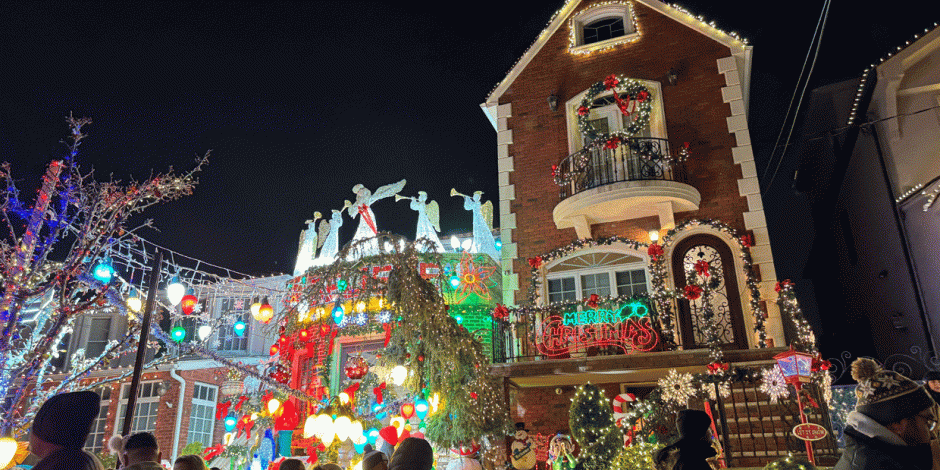
Decorating for some holiday (N. Am.)hier: Fest; auch: Weihnachts-holidays is like a sport to many Americans. In the weeks leading up to Halloween, you’ll see large skeletons and spiders crawling all over people’s lawns. And during the Christmas season, many houses are covered in intricateanspruchsvollintricate light displays.
Several American Christmas customs have their origins in Germany, such as putting up a tree. However, while the German tradition is to light candles on the tree, Americans chose to use light bulbs instead, starting in the late 1800s.
American businessman Thomas Edison invented the light bulbGlühbirne (light-bulb moment = Aha-Erlebnis)light bulb in 1879. Around Christmas 1882, one of his associates, Edward Hibberd Johnson, realized that a string of lights on Christmas trees was less of a fire risk than burning candles.
By 1894, The New York Times had reported on Johnson’s display. A decade later, President Grover Cleveland used light bulbs to decorate the White House Christmas tree for the first time. And, in 1903, the company General Electric began selling specially packaged Christmas lights.
Outdoor Christmas light displays became widespread in the 1920s and 1930s, during the Great Depression(Welt)Wirtschaftskrise nach dem Börsenkrach 1929Great Depression. Their “bright appearance was used to create a veneerFassade, schöner Scheinveneer of prosperityWohlstandprosperity on city streets where businesses struggled,” Smithsonian magazine reported.
Once the U.S. power gridStromnetzpower grid was completed, after World War II, the tradition expanded to single-family homes. By 2016, an estimated 80 million American homes were decorated with Christmas lights. American homes and yards are typically larger than those in Europe, allowing for more extravagant displays.
When I was growing up, one of my neighbors go all outsich ins Zeug legenwent all out with his decorations. He dressed up the white columns of his house like candy cane (N. Am.)rot-weiß gestreifte Zuckerstange, meist mit Pfefferminzgeschmackcandy canes and installed bright, flashing sculptures of figures such as Frosty the Snowman and Rudolph the Reindeer in his yard. During the dark winter months, seeing his home was a magical experience for everyone on our street.
But there’s a not-so-glittering element to the holiday cheer: all the energy that Christmas lights consume. Americans generally pay less attention to their energy usage than Europeans because electricity in the United States is cheap.
In December 2016, those outdoor lights used up around six percent of the United States’ entire electrical loadStromverbrauchelectrical load. An even more staggeringgigantischstaggering statistic: American Christmas lights consume more energy than El Salvador, Ethiopia, and Tanzania each do in an entire year!
Exercises
1. Twinkling truths
1. Twinkling truths
EASY
Match the magic
2. Match the magic
MEDIUM
Neugierig auf mehr?
Dann nutzen Sie die Möglichkeit und stellen Sie sich Ihr optimales Abo ganz nach Ihren Wünschen zusammen.